A field note from Cohere Solutions on the case for treating Durban, Ngqura and Saldanha Bay as a single freight corridor — and why 2026 is the year to actually do it.
South Africa has something almost no other country on earth has: two ocean coastlines, joined by one rail network, with three deep-water ports sitting on them. Durban faces the Indian Ocean and Asia. Saldanha Bay faces the Atlantic. And in between, Ngqura sits at Gqeberha with one of the deepest approach channels on the continent.
Nobody currently treats these three ports as one thing. Each is planned, funded, and run as its own island. This piece — a companion to our full whitepaper on the subject — makes the case for changing that, in plain terms, with the numbers that convinced us.
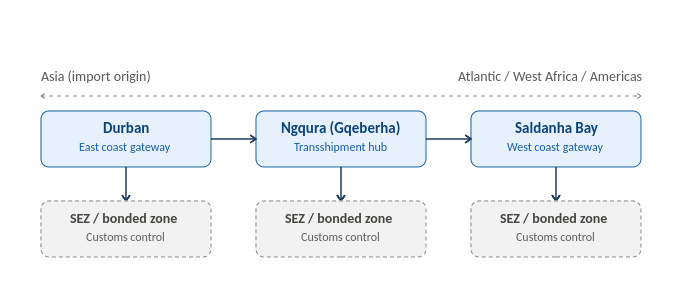
The idea, in one picture
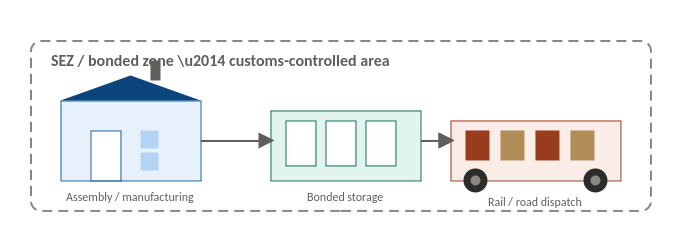
Cargo from Asia lands at Durban. Instead of every container waiting for a ship to sail all the way around the Cape of Good Hope to reach Atlantic markets, some of it moves overland by rail — through Ngqura's transshipment function — to Saldanha Bay, where it catches an Atlantic-bound sailing. Pair each port with a bonded special economic zone, and South Africa stops being a place cargo just passes through and starts being a place value gets added.

Why now, and not five years ago
Three things changed in 2025 and 2026 that make this the right moment:
- Transnet's rail monopoly is over. Eleven private operators signed agreements in May 2026 to run trains on the national network for the first time in the company's history.
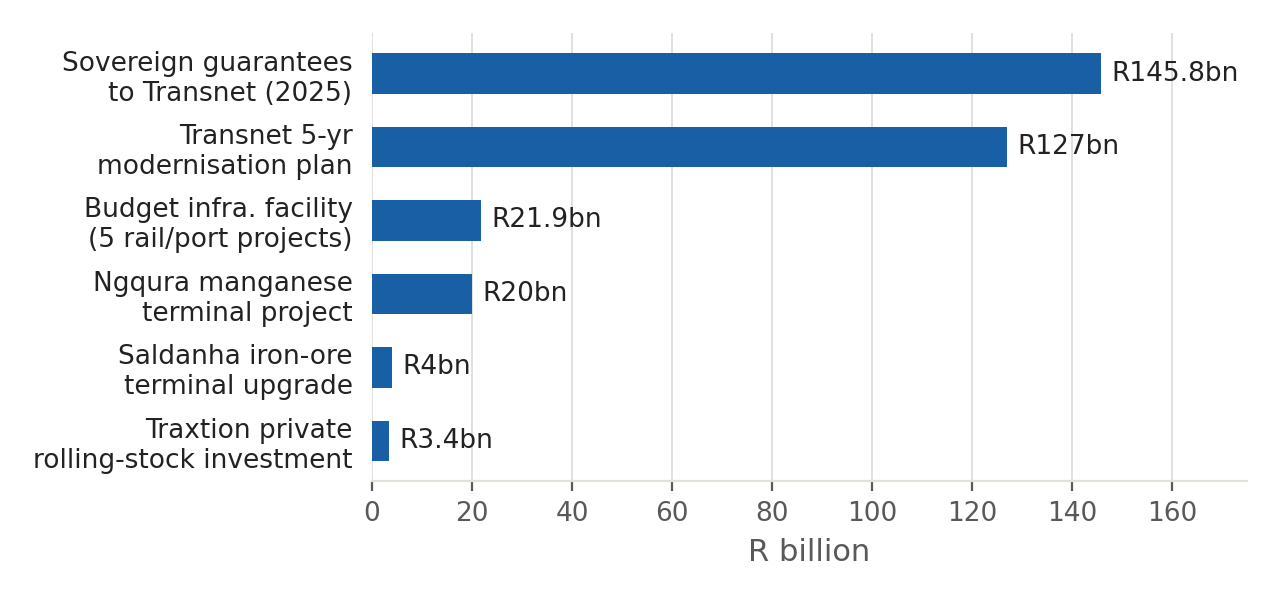
- The state put real money behind the reform. R51 billion in guarantees in mid-2025, another R94.8 billion later that year — alongside a R127 billion five-year modernisation plan.
- The ports are already improving, independently verified. Durban and Ngqura were rated the most- and third-most-improved ports in the world in the 2025 Container Port Performance Index.
It's not about beating a container ship on price — it's about not routing past a closer port
Ocean freight beats rail on cost per tonne over distance. Everyone knows that, and it doesn't need three paragraphs to establish.
The real argument is simpler and more useful: South Africa currently routes a disproportionate share of its own mining and industrial output through Durban by default, not because Durban is the closest or cheapest port for that cargo, but because that's where the infrastructure and shipping schedules happen to be concentrated. A mine sitting physically closer to Saldanha or Ngqura often still ships via Durban, absorbing hundreds of extra kilometres of pure overland cost, simply because the Durban corridor is the one that reliably exists. That's a self-inflicted cost, and it's fixable.
It's already being fixed in one case: Transnet's planned manganese export terminal at Ngqura exists specifically to give Northern Cape manganese producers a shorter route than the long haul many currently face to Durban or the older Port Elizabeth terminal. A proper corridor — with the shared digital freight-visibility system we describe below — makes that the rule instead of a one-off fix: shippers choose the nearest, cheapest port for their specific cargo in real time, instead of defaulting to whichever gateway has the most established schedule.
None of that works, though, if South Africa's ports don't have somewhere useful to send cargo once it arrives — and that's where the deep-water hub-and-spoke mechanics of global shipping come in. The biggest ships afloat — 20,000-plus TEU container ships, VLCC oil tankers, VLOC ore carriers — need water depth that most ports simply don't have. Shipping lines concentrate them at a small number of hub ports and redistribute cargo from there. A supertanker doesn't call at every port on a coastline; it calls at the few ports deep enough to take it.

That's the underlying asset South Africa is sitting on and under-using:
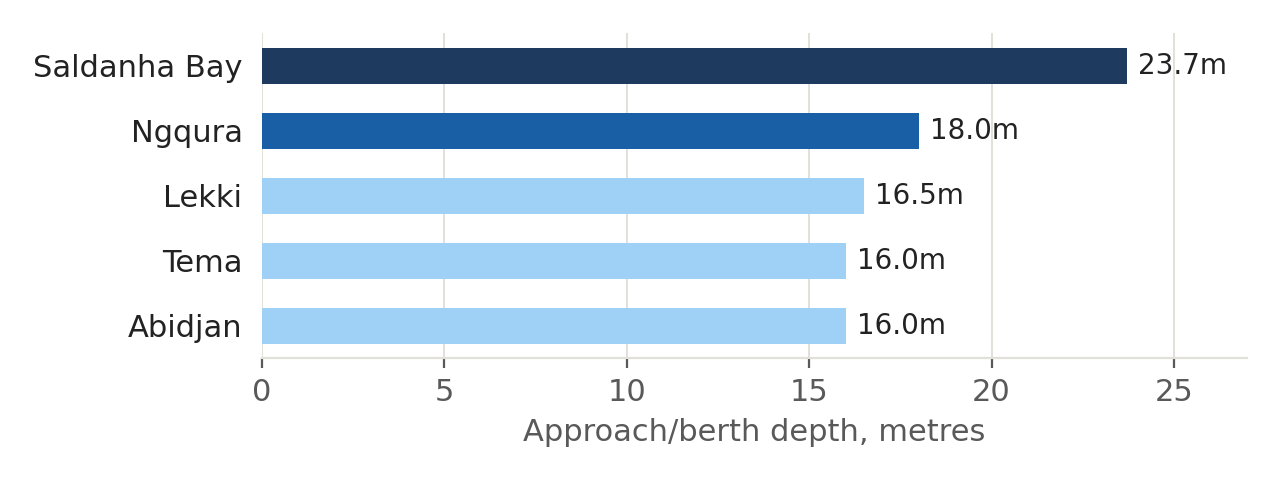
Saldanha's 23.7-metre depth and Ngqura's 18-metre channel put them ahead of even West Africa's newest deep-water terminals at Lekki, Tema and Abidjan. That's the scarce asset that makes the routing-optionality argument above worth anything at all — rail and the ports it connects are the spoke that redistributes cargo those depths attract, and the corridor is what lets South Africa stop shipping its own goods past a closer port to reach a farther one.
The numbers that actually matter
We didn't want this to be a vision document with no math in it, so here's what the sourced figures say.
South Africa's logistics cost problem is real and expensive. At 11–12% of GDP against 8–9% in advanced economies, the gap is worth on the order of R230 billion a year.
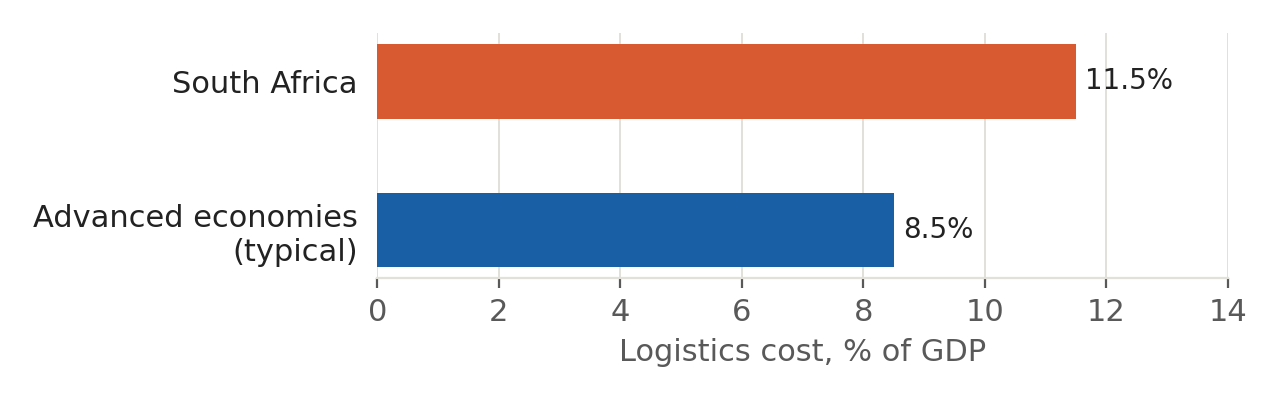
The capital isn't hypothetical — it's already moving. Between Transnet's modernisation plan, sovereign guarantees, and individual terminal projects, well over R300 billion (with real overlap between categories) is already committed or guaranteed to the rail and port system this corridor would run on.
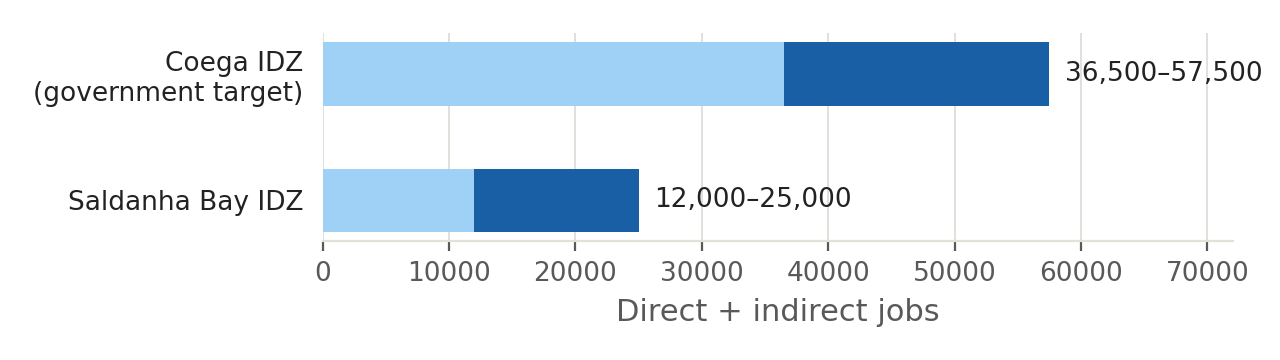
The jobs precedent already exists. We didn't invent a jobs number — we added up what the two relevant industrial development zones have themselves published: Saldanha Bay IDZ's 12,000–25,000 and Coega's government target of 36,500–57,500. Durban isn't even counted, because no comparable figure has been published there yet.
The part that isn't just about South Africa
Landlocked SADC countries — Zambia, Zimbabwe, Botswana, Malawi, Lesotho, Eswatini — already send more than half their trade through South African ports and rail, because they have no coastline of their own. That's not a hypothetical opportunity, it's the status quo.
What's less comfortable: it's a status quo other people are actively trying to take. The Lobito Corridor, running from Angola's Atlantic coast to the copper belt in the DRC and Zambia, just secured a $500 million, 30-year concession specifically to pull that copper traffic away from routes through South Africa. DP World and Abu Dhabi Ports have bought operational positions in ports across South Africa, Tanzania, Mozambique, the DRC and Angola — Gulf capital positioning itself as the region's gateway operator regardless of which country's ports it actually uses.
That reframes the whole pitch. This isn't purely a growth story. It's also a defensive one: South Africa's default share of Southern Africa's trade will keep eroding if its own corridor stays less reliable than the alternatives being built around it.
Where the case is strong, and where it isn't
It's tempting to pitch South Africa as an "African Suez Canal," solving West and East Africa's port congestion equally. The reporting doesn't support that evenly:
- East Africa: genuine opening. Mombasa was reporting close to five-day vessel waits in early 2026 from congestion and equipment shortages. Durban and Ngqura's CPPI improvements are a real, current advantage on that side.
- West Africa: a narrower, more honest claim. Nigeria, Ghana and Côte d'Ivoire have all built their own deep-water terminals in the last few years — Lekki alone reaches 16.5 metres. Tangier Med, not any southern African port, still dominates Atlantic-side African transshipment. Saldanha's real value on that side is the land-bridge and energy-hub case, not a claim to out-compete ports that are already solving their own problem.
The narrower claim is the one that holds up.
South Africa isn't the first country to solve this — India already did
India had a version of this exact problem: a handful of saturated main lines carrying most of the country's freight, choked by mixed passenger and freight traffic. Its answer was the Dedicated Freight Corridor programme — 2,843 km of new freight-only track, 96% of it now operational, with train volumes up 47.5% in a single year (2023/24 to 2024/25).
The financing is the part worth copying. India built it on a 3:1 debt-to-equity structure: government equity paired with concessional debt from the Japan International Cooperation Agency (Western Corridor, ~550 billion yen) and the World Bank (Eastern Corridor, roughly $2.7 billion across three tranches, at around 0.7% plus LIBOR). India has since started refinancing that debt domestically as its own credit position improved — a clean graduation path from concessional multilateral debt to self-financing.
The World Bank's own appraisal of the project wasn't shy about what it was actually for: its report on the Eastern Corridor's impact was titled "from freight corridor to growth corridor," measuring the project by regional job creation, not freight tonnage. JICA describes the Western Corridor as the literal backbone of the Delhi-Mumbai Industrial Corridor. The rail line was financed as industrial-development infrastructure first, freight infrastructure second — exactly the frame we'd argue for Durban, Ngqura and Saldanha.
Two honest differences from India, though. South Africa doesn't have India's core problem of passenger trains fighting freight for the same track — Transnet Freight Rail already runs a largely freight-dedicated network, so this is restoration and hardening, not building a brand-new parallel alignment. And unlike India's fully electrified DFC, South Africa doesn't need to electrify every remaining segment to make this work; much of the corridor already is, and selective electrification where traffic density justifies it keeps the capital ask closer to a coordination-layer problem than a full rebuild.
That's the pitch for the World Bank, the African Development Bank, and bilateral development finance institutions: this is a well-understood category of asset with a two-decade financing track record, not a novel risk.
The bottom line
Nothing about this corridor requires inventing new infrastructure. The rail lines connecting all three ports already exist. The reform that opens the network to private operators already passed. The tax structure that would make South African assembly attractive to Asian manufacturers — a 15% corporate rate inside a Special Economic Zone, versus 27% standard — is already law. What's missing is the decision to run Durban, Ngqura and Saldanha Bay as one corridor instead of three unrelated ports competing quietly for the same scarce national attention.
The full whitepaper, with sourced footnotes and a phased implementation roadmap, is available on request from Cohere Solutions.